
James Thomson
Maker
William Aikman
(Scottish, 1682 - 1731)
SitterSitter:
James Thomson
(British, 1666 - 1716)
Attributedpreviously attributed to
William Hogarth
(British, 1697-1764)
ClassificationsPAINTINGS
Dateca. 1726
Mediumoil on canvas
Dimensionscanvas: 30 1/8 × 26 in. (76.5 × 66 cm.)
frame: 39 1/2 × 34 1/2 × 3 1/4 in. (100.3 × 87.6 × 8.3 cm.)
Credit LineThe Huntington Library, Art Museum, and Botanical Gardens
Status
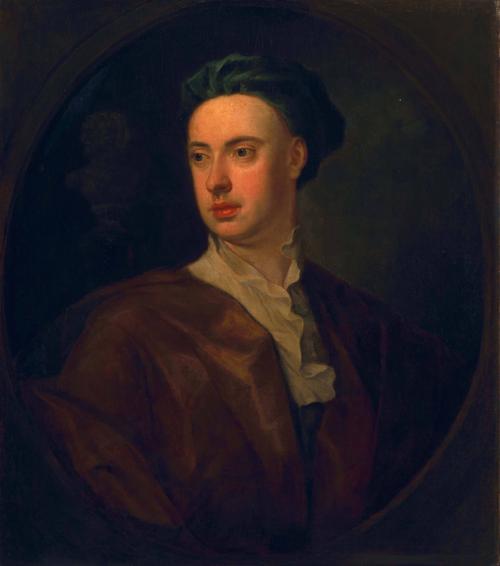
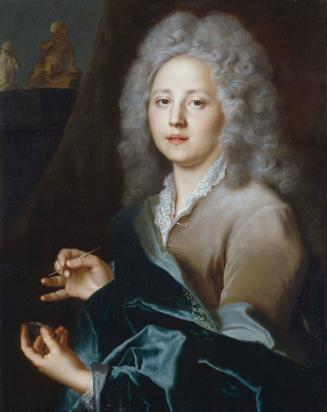
Not on viewThomson is represented in the self-consciously artistic dress that eighteenth-century portraitists often employed for men of creative temperament. A subsequent painting by John Patoun (c. 1746) and a marble plaque by an unknown sculptor (n.d.) portrayed Thomson wearing the same combination of velvet turban, linen shirt, and silk drapery. The lack of articulated shoulders in the drapery of the present portrait indicates that the poet is not wearing a sleeved gown, but a large piece of silk, loosely draped in a style reminiscent of the togas and mantles found in antique statues of philosophers and statesmen. The drapery literally cloaks Thomson in classical authority and gravitas. At the same time, it conveys an air of informality appropriate to the sitter's personality. Notoriously indolent, Thomson was reportedly negligent in his dress, although "a dandy in the matter of perukes."[5] Here, a peruke or other contemporary wig would have seemed glaringly anachronistic in combination with the pseudo-classical drapery, and the artist instead shows Thomson wearing a turban on his shaved head. By eliminating such artificial adornments as a wig and contemporary costume, the artist signifies that he shows us the essence of the man, as known to those intimates who would see him in this state of informal undress. The importance of this painting has long been overlooked, its authentic qualities hidden beneath disfiguring overpaint applied by an unknown restorer sometime prior to acquisition by Henry Huntington. Recent x-radiography has revealed the sophistication of the underlying painting, showing that the forms of the face and drapery were originally blocked in with a confidence and skill belied by subsequent insensitive restoration work. What we have here, it now appears, is a painting that has previously been presumed lost: William Aikman's portrait of his friend and countryman James Thomson at the age of twenty-five. The existence of such a portrait has long been known through an engraving by James Basire, published in 1761 with an inscription specifying the name of the artist and sitter, as well as the sitter's age when the painting was originally executed. Most of the differences between our painting and the engraving--such as the patterns of the drapery folds--can now be attributed to the hand of the restorer.
One difference cannot be explained in this way: the sculpted figure positioned in the left background of our painting, which is absent from the print. The sculpture represents Janus, the Roman god of all beginnings, for whom the month of January was named. Janus would have made an appropriate emblem for Thomson in 1726, the year in which (at the age of twenty-five) he published "Winter," the first of the Seasons poems for which he would become famous. It is likely that Aikman (perhaps with a commission from one of Thomson's wealthy supporters) executed the painting as a mark of respect for the author, and that the Janus figure was sketched in, perhaps as an afterthought, in tribute to the poem that was swiftly bringing him literary prominence. Under similar circumstances, Stephen Slaughter carried out a portrait of Thomson in 1736 to commemorate the publication of his poem "Liberty".
The embedded reference to "Winter" implicit in the Janus figure thus strongly supports a date of 1726 for the Huntington painting. This would agree with Basire's inscription, which states that the engraving is modeled on a painting of Thomson at the age of twenty-five. Confirmation of our portrait's early date is provided by the likeness of the sitter, which reflects the handsomeness of his youth, rather than the stolid and corpulent appearance of his mature years, when Samuel Johnson described him as possessing "a dull countenance, and a gross unanimated, uninviting appearance." By 1761, when Basire engraved the Aikman portrait, the Janus figure would have seemed less pertinent, as the individual poem "Winter" had by then been subsumed within the completed "Seasons" collection. Basire presumably excised the sculpture from his engraving as an irrelevant detail.
Aikman may have painted his friend Thomson on an earlier occasion. A portrait in the National Portrait Gallery of Scotland bears an inscription of unknown date identifying the painter as Aikman and giving the year as 1720. Three years later, Aikman abandoned Scotland to pursue his fortune in London, with Thomson following on his heels in 1725. The present portrait was executed the next year, by which time Aikman was near the end of his career. He died in 1731, and Thomson commemorated the occasion in verse. Thomson's own posthumous fame was boosted by the efforts of his friend Lord Lyttelton. New editions of the poet's work ensured that his influence and renown grew into the mid nineteenth century, when he sustained a high reputation as an important precursor of the Romantic movement in Britain and France. It was this sustained interest which led James Basire to engrave Aikman's portrait of Thomson thirteen years after the poet's death.
Object number20.23
Edward Burne-Jones
ca. 1930
Object number: 2000.5.1010
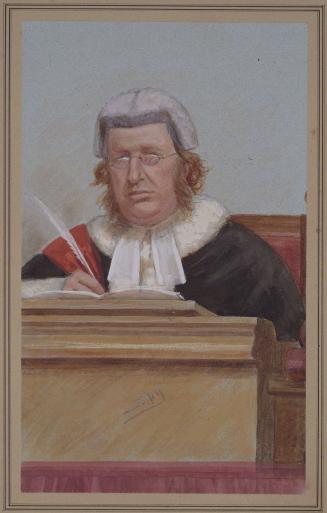
Leslie Matthew Ward (Spy)
n.d.
Object number: 91.284.145