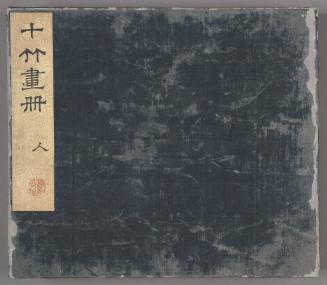
Calligraphy in Bamboo Frame
Compilercompiled and edited by
Hu Zhengyan 胡正言
(Chinese, ca. 1584 - 1674)
Additional Title(s)
- Ten Bamboo Studio Manual of Calligraphy and Painting (Shizhuzhai shuhua pu) 十竹齋書畫譜; volume 3 (Man)
ClassificationsPRINTS
Date1633
DynastyMing dynasty
Mediumink and color on paper
Dimensionsbook: 9 3/4 x 11 1/4 in. (24.8 x 28.6 cm.)
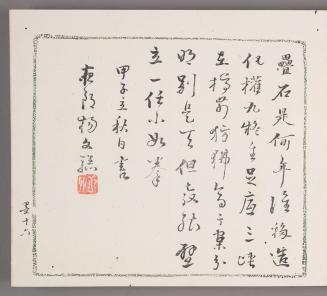
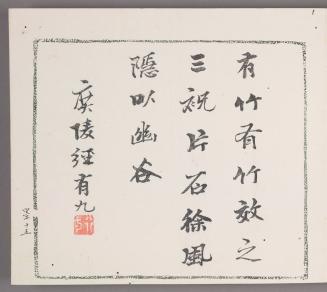
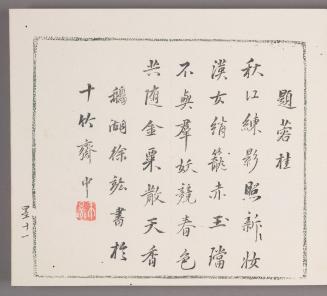
DescriptionOne page from a woodblock printed book mounted as an album leaf
Inscribed昔同陶令酒,今愜野人情。欲織靈均意,籬邊采落英。
詠菊 梁溪華與進書.
Hand-written inscription, lower left: Ink 10 (mo shi) 墨十
MarkingsSeal (白文)
Credit LineThe Huntington Library, Art Museum, and Botanical Gardens. Purchased with funds from June and Simon K.C Li, Fong Liu, Mei-Lee Ney, and Anne and Jim Rothenberg, in honor of Steven S. Koblik
Status
Not on viewPoem title:
“In Praise of Chrysanthemums”
Poem:
In the past, they accompanied Magistrate Tao’s wine;
today, they satisfy reclusive sentiments.
If you wish to know Lingjun’s spirit,
then pick the fallen flowers by the fence.
References:
Magistrate Tao is Tao Yuanming (ca. 365–427), a poet who loved chrysanthemums and wine.
Lingjun is the pseudonym of Qu Yuan (active ca. 300 BCE), an early poet.
Pick . . . by the fence is a phrase from a poem by Tao about chrysanthemums.
Fallen flowers refers to chrysanthemums that are eaten. They appear in poems by both Tao and Qu.
Chrysanthemums are more than just ornamental flowers. Some varieties can be brewed to make teas. Others are used to treat sore throats, headaches, and vision problems. Long-term consumption is said to lighten the body and prevent aging.
Portfolio or SeriesVolume 3
Object number2014.7.3.61

Physical/Intellectual