
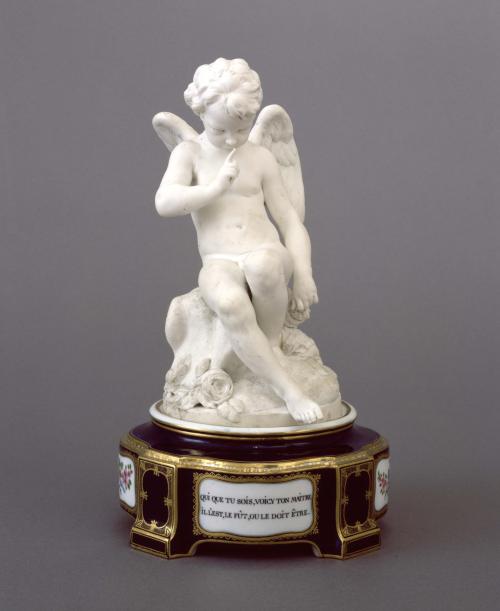

Cupid
Maker
Sèvres Porcelain Manufactory
(French, active from 1756 to the present)
Modelfigure after model by
Etienne Maurice Falconet
(French, 1716 - 1791)
Formerformerly attributed to
Henri Bulidon
(French, act. 1745 - 1759)
Additional Title(s)
- Cupid (L'amour Falconet)and pedestal (piédestal de l'amour)
- L'amour Falconet
- Cupid Warning
ClassificationsSCULPTURE
Datefigure: 1766-1773; pedestal: 1760
Mediumfigure: unglazed soft-paste porcelain
pedestal: soft-paste porcelain, underglaze blue ground color, polychrome enamel decoration, black enamel inscription; gilding
Dimensionsfigure: 9 × 4 3/4 × 6 3/4 in. (22.9 × 12.1 × 17.1 cm.)
pedestal: 3 × 6 1/2 × 6 1/2 in. (7.6 × 16.5 × 16.5 cm.)
Signed
Inscribedfigure: outer edge of the base incised in the bisque, B, the mark of Jean-Jacques Bachelier.1
pedestal: painted underneath in blue enamel with the crossed Ls of the Sèvres manufactory enclosing the date letter H for 1760; below the Ls is an X, Micaud's mark;2 incised underneath, in the bisque, cn3
Credit LineThe Huntington Library, Art Museum, and Botanical Gardens. Adele S. Browning Memorial Collection, gift of Mildred Browning Green and Honorable Lucius Peyton Green
Status
Not on viewThe same year Falconet exhibited his marble Cupid at the Salon of 1757, he was appointed head of the sculpture studio at the Royal Porcelain Manufactory at Sèvres, a post he would hold until 1766, when he left France for Russia. In the early 1750s, the manufactory had begun making unglazed porcelain figures, known as biscuit, that were popular because of their resemblance to marble. By the time of Falconet's appointment, the production of biscuit porcelain figures had become a significant part of the factory's output. Falconet's model for the biscuit figure of Cupid, a reduced copy of his marble original, was put into production in 1758 (for a discussion of copies, see the essay by Malcolm Baker in this volume). It became one of the most popular figures sold at Sèvres and was referred to there as L'Amour Falconet. It was initially made in one size (approximately 9 inches or 23 cm high) and usually sold for 96 livres as an independent work that could be displayed under a glass case, although some were sold with dessert services to be part of a table decoration. This example is marked with a B in script, indicating that it was produced at the manufactory while Jean-Jacques Bachelier was head of the sculpture studio between 1766 and 1773.
A pendant female figure, Pendant de l'amour Falconet, was introduced at Sèvres in 1761 after a design by Falconet made specifically for the royal manufactory and not as a separate sculpture in other media. It later became referred to as Psyche, and was often sold as a pair with L'Amour Falconet. Between 1761 and 1770 more than 230 pairs were sold.
The model for the octagonal pedestal on which the figure loosely rests was introduced by 1760. Because it was initially designed to accompany the figures of Cupid, the pedestal was referred to as a piédestal de l'amour. This is the earliest known dated example and predates the figure of Cupid that it currently supports. It is not known when this pedestal and figure were brought together. The shape appears to be a modification of the base for the vase hollandois nouveau (see cat. 78-80), a model that was introduced during the late 1750s. This example is decorated with an underglaze blue ground with four shaped white rectangular reserves at each of the long sides. Three of the reserves are painted with polychrome sprays of flowers. The front reserve has the inscription in French, "QUI QUE TU SOIS, VOICI TON MAITRE / IL L'EST, LE FÛT, OU LE DOIT ÊTRE" (Whoever you are, Here is your master [Love], He is, was, or should be [your master]), a well-known couplet composed by Voltaire for another sculpture representing Cupid that was produced earlier in the eighteenth century.
Object number78.20.56
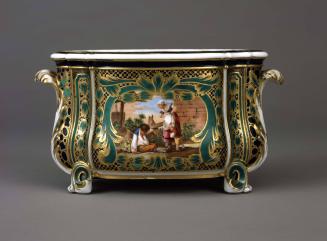
![Vase [1 of 2]](/internal/media/dispatcher/25148/thumbnail)
![Vase [ 2 of 2]](/internal/media/dispatcher/25150/thumbnail)
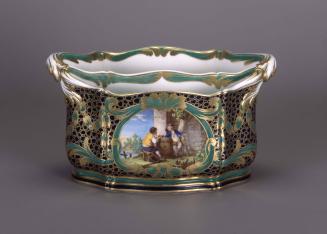
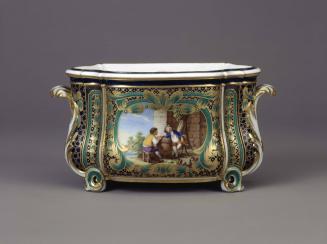
![Vase [1 of 3]](/internal/media/dispatcher/27919/thumbnail)
![Vase [2 of 3]](/internal/media/dispatcher/27921/thumbnail)
![Vase [3 of 3]](/internal/media/dispatcher/27922/thumbnail)
![Lidded Vase [2 of 2]](/internal/media/dispatcher/25129/thumbnail)
![Lidded Vase [1 of 2]](/internal/media/dispatcher/61405/thumbnail)