
Benjamin Franklin
Attributedattributed to
Jean Valade
(French, baptized 1710 - died 1787)
Afterafter
Joseph Siffred Duplessis
(French, 1725 - 1802)
Formerformerly attributed to
Joseph Siffred Duplessis
(French, 1725 - 1802)
ClassificationsDRAWINGS
Date1778
Mediumpastel on blue paper adhered to linen
Dimensions28 1/2 × 22 1/2 in. (72.4 × 57.2 cm.)
6 1/4 × 38 1/4 × 33 3/4 in. (15.9 × 97.2 × 85.7 cm.)
Credit LineThe Huntington Library, Art Museum, and Botanical Gardens
Status
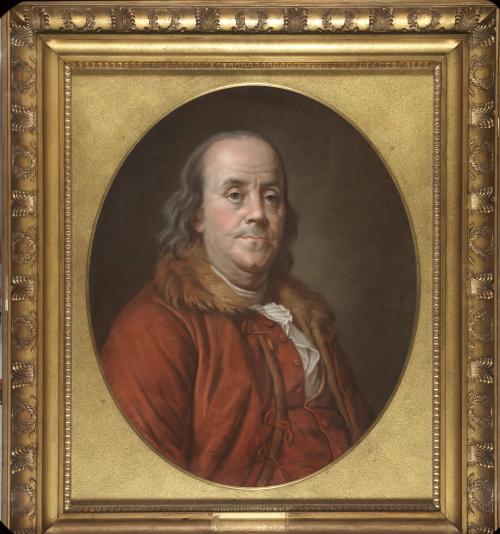
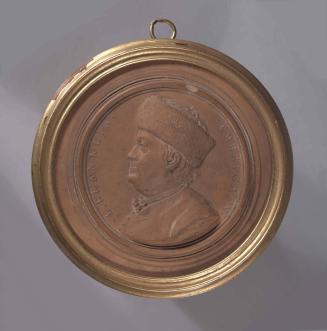
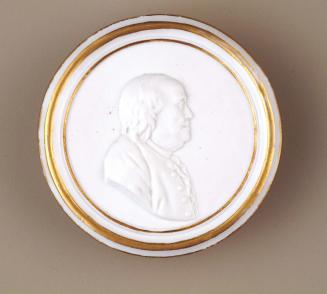
Not on viewFrench artists were fascinated by Franklin's Quaker simplicity. Whether clad in rustic furs or plain cloth and linen, he seemed the living embodiment of the democratic beliefs for which America was fighting. Franklin complained: "I have at the request of Friends sat so much and so often to painters and Statuaries, that I am perfectly sick of it. I know of nothing so tedious as sitting hours in one fix'd posture." But the demand for portraits of the American patriot was insatiable.
No artist captured Franklin's physical and psychological likeness as successfully as did Duplessis, and his iconic portrait (fig. 00) was hailed as a masterpiece when it appeared in the Salon of 1779.One critic commented: "His large forehead suggests strength of mind and his robust neck the firmness of his character. Evenness of temper is in his eyes and on his lips the smile of an unshakeable serenity." Copies appeared for sale almost immediately. Franklin encouraged this; the portrait was a personal favorite, and reproductions saved him the trouble of sitting to other artists. The present pastel is probably one of the replicas of the portrait made in the 1780s. Several contemporary oil copies, miniatures, and engravings exist, both by Duplessis and by other artists. However, pastel versions of this composition are scarce; there is only one other known, in collection of the New York Public Library. It was not unusual for artists to copy oil paintings in pastels. The technique, imported from Italy, flourished in eighteenth-century France, its vibrancy and smoothness appealing to artists and patrons alike. Pastel drawings were less expensive than oil paintings and could be produced faster, attributes particularly appropriate in the case of a busy and impatient man such as Franklin. Sellers has suggested that the New York pastel (once owned by Franklin himself) was Duplessis' preparatory sketch for his oil portrait Although the pose is identical, the costume is strikingly different: Franklin wears a conventional gray suit. The Huntington version matches the oil portrait.
The pastel is in its original frame, which is identical to that of an oil version of the portrait attributed to Jean Valade (1709-1787), peintre ordinaire to Louis XVI. Unlike Duplessis, Valade was a noted pastellist as well as a painter and is known to have made pastel copies of oil paintings by other masters. It seems likely, therefore, that The Huntington's pastel is by Valade. The date is estimated to be between 1778, when Duplessis painted the original, and 1787, when Valade died.
Object number53.4
Enoch Wood & Sons
ca. 1824
Object number: 2017.5.47
Staffordshire
ca. 1824
Object number: 2017.5.47.1
Staffordshire
Object number: 2017.5.47.3