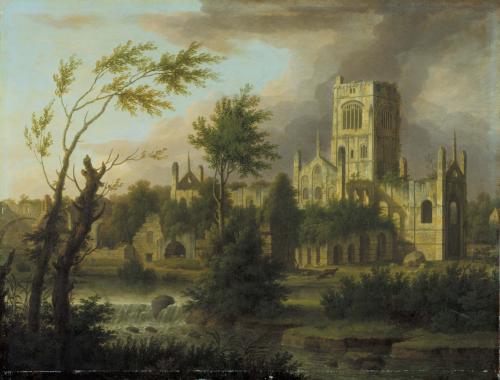

South East View of Kirkstall Abbey, Yorkshire
Maker
George Lambert
(British, 1710 - 1765)
ClassificationsPAINTINGS
Date1749
Mediumoil on canvas
Dimensionscanvas: 24 1/4 × 31 1/2 in. (61.6 × 80 cm.)
frame: 31 1/2 × 39 × 2 3/4 in. (80 × 99.1 × 7 cm.)
SignedSigned and dated lower right: G. Lambert 1749
Credit LineThe Huntington Library, Art Museum, and Botanical Gardens
Status
Not on viewIt would appear that Lambert modeled this painting on an unlocated picture by Thomas Smith of Derby, which Lambert could have known through an engraving by François Vivares (1709-80), published in January 1747. Lambert's painting makes significant deviations from Vivares's print, however, and these may reflect the dramatic approach to landscape that he developed as a scenery painter at Covent Garden Theatre. The addition of a central tree and the enhanced prominence of the shrubbery create a dark screen through which we glimpse the abbey more obscurely. What the artist conceals of the ruin, as much as what he reveals, piques the viewer's interest and infuses the scene with a subtle note of mystery and suspense.
Lambert further dramatized the mood of the place by enhancing the storminess of the sky. The foreboding gray cloud that rises directly from the top of the tower emphasizes the abbey's impressive height. Lambert draws further attention to the tower by means of the tall, spindly tree in the far left foreground, which he has endowed with a gestural quality that is far more explicit here than in Vivares's print. Lambert draws greater attention to the blasted trunk beside this gestural tree, presenting it in starker isolation so that its shriveled appearance provides a motif of decay equivalent to that of the abbey itself. Throughout the painting, Lambert has used the vague softness of the foliage as a counterpoint to the building's hard, linear definition, which he delineates with uncharacteristic precision.
Most significant of all is the absence of the polite figures that Vivares shows rowing on the water and admiring the ruin from the ground. By replacing this sociable human element with grazing cattle, Lambert creates a more solitary view. Significantly, in a larger version of the present painting, executed two years earlier, the artist had included elegant visitors gazing at the tower, and a rustic figure bathing in the water (Yale Center for British Art). The Huntington painting represents Lambert's reconsideration of those features. With only nature encroaching on the desolate walls of the ruin, the scene appears all the more haunting and evocative.
Bibliography
Object number97.15
Martin Jacob Jackson
1927
Object number: 2022.16.16
Martin Jacob Jackson
1923
Object number: 2022.16.11
Lambert de Visscher
c. 1680
Object number: 41.5.792
John Hilling
ca. 1854
Object number: L2015.41.177.1