
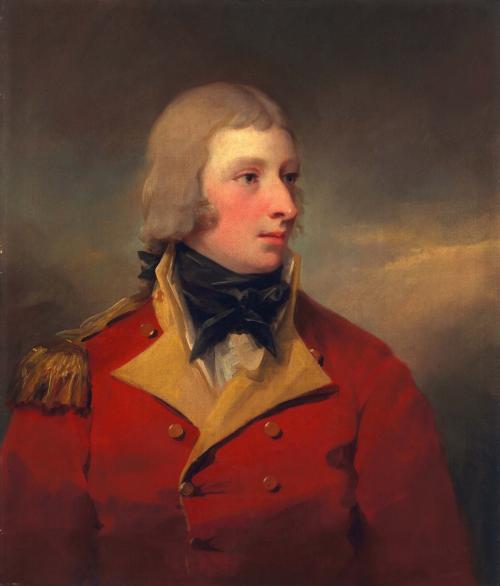

Lieutenant Andrew Agnew
Maker
Henry Raeburn
(British, 1756-1823)
SitterSitter:
Lieutenant Andrew Agnew
(British, 1766 - 1792)
ClassificationsPAINTINGS
Dateca. 1795
Mediumoil on canvas
Dimensionscanvas: 29 3/4 × 24 3/4 in. (75.6 × 62.9 cm.)
frame: 39 × 33 1/2 × 3 in. (99.1 × 85.1 × 7.6 cm.)
DescriptionBust length, facing right, dressed in red military coat with gold collar and epaulets, grey powdered hair tied back with black ribbon. Background of sky and clouds.
Credit LineThe Huntington Library, Art Museum, and Botanical Gardens. Bequest of Florence M. Quinn
Status
Not on viewRaeburn represents Andrew Agnew in the scarlet uniform with yellow facing and piping that he wore during his four years as a lieutenant in the 12th Regiment, from 1788 to 1792. On the basis of his military service, a date of c.1791 has generally been accepted for this portrait. However, it is difficult to pinpoint when during that period Agnew could have sat to Raeburn. The painter had by then established his practice in Edinburgh, but Agnew was absent from Scotland during the whole of his military career, with the exception of "a flying visit" from the Channel Islands in 1789 on the occasion of his sister Isabella's marriage at Lochnaw. Even then, the terms of his leave would certainly not have granted leisure for sittings in a portraitist's studio in Edinburgh. On leaving southern England in January 1791, Agnew went directly to Ireland and remained there until July 1792, when the promise of reconciliation with his father following his elopement with Martha de Courcy caused him to make haste for Lochnaw. He died two months later.
It seems likely, therefore, that this portrait was executed posthumously. Although Raeburn's paintings are difficult to date on stylistic grounds, aspects of the present work support a date in the mid 1790s. The features of the face have been observed with some sensitivity and care, but their effect is spoiled by the cursory rendering of the hair as a flat slab entirely lacking in structure and texture. The relationship of the head and hair is similar in Raeburn's portrait Major General Alexander Murray MacGregor as a Young Man of c.1795, which further resembles the present painting in the brisk painting of the tassels of the epaulette and the rendering of puckers and folds in the uniform. Something of the energy of Raeburn's characteristic "square touch" is apparent in the crisply blocked forms of Agnew's cravat, collar, and shirt, but the rest of the drapery appears dull and flaccid.
Even allowing for the weakened sense of structure resulting from chemical abrasion, there is a peculiar vagueness about the portrait--a lack of convincing personality in the summarily sketched head and of corporeality in the seemingly empty coat--which might indicate that Raeburn painted a man he never actually saw. It would not be unusual for an artist to have made such a portrait, working from a drawing or miniature supplied by the family. Although perfectly consonant with the illustrious military heritage of the Agnew family, Raeburn's portrait offers an ironic tribute to a man who had decisively chosen love over war.
Bibliography
Object number44.99
John Hoppner
ca. 1789
Object number: 24.31