
David Garrick
Maker
Unknown
FormerFormerly attributed to
Robert Edge Pine
(British, 1730-1788)
SitterSitter:
David Garrick
(British, 1717 - 1779)
ClassificationsPAINTINGS
Dateca. 1775
Mediumoil on canvas
Dimensions27 x 22 1/8 in. (68.6 x 56.2 cm.)
Credit LineThe Huntington Library, Art Museum, and Botanical Gardens
Status
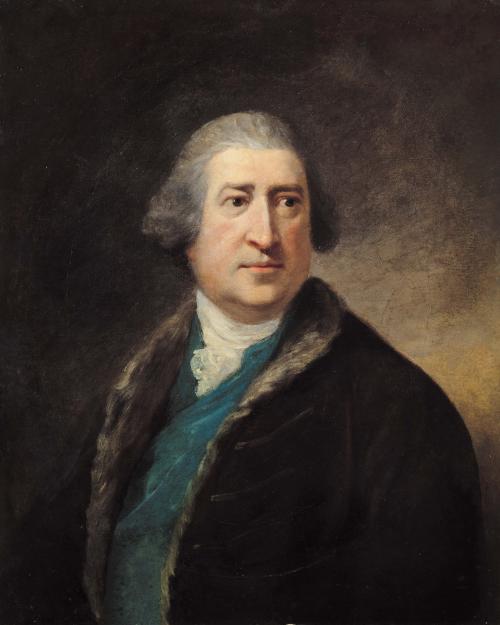
Not on viewThis painting was acquired by The Huntington as a work by Robert Edge Pine (c.1720-88), who produced a number of portraits of Garrick, all of which are modeled on a single, mask-like conception of the actor's face. The present portrait deviates entirely from this standard type, and although unquestionably a likeness of Garrick, it is probably not by Pine. It most closely resembles a pencil sketch of Garrick by Edward Edwards, signed and dated 1777, which purports to be the last drawing made directly from life prior to the actor's death two years later. Although Garrick's phenomenal fame led at least one other artist to promote his portrait as "the last" likeness made of him, Edwards's inscribed date carries some authority. The likeness itself offers a convincing image of Garrick at the age of sixty, prematurely aged by illness and, as Samuel Johnson claimed, by the "eternal, restless, fatiguing play of the muscles" occasioned by his vivacity, which "must certainly wear out a man's face before its real time."
After making allowances for flattery, it would appear that the present portrait was made slightly earlier than Edwards's drawing, before the ravages of Garrick's chronic illness had taken their full toll. The deep furrows recorded in the drawing are absent from the painting, but there is a hint of the same jowliness in the thickened jawline. The grave, though pleasant, expression and the dulled eye (once famous for its lively glitter) convey a subdued impression similar to that in the drawing. The advanced age and dampened mood of the painting are highly idiosyncratic relative to other likenesses of the actor, which fall in line with Samuel Johnson's characterization of Garrick as "the Cheerfullest man of his age." The unusual conception suggests that this painting was made from the man himself, rather than modeled on one of his prior portraits.
Equally unusual is the vivid blue of Garrick's vest, which is rather bright for an English context. His fur-lined coat, too, has a slightly exotic quality; it was an article of dress frequently adopted by Englishmen on the Continent but worn less frequently at home. The artist's intention may have been to dissociate Garrick from his profession, portraying him as a well-travelled and sophisticated man of the world, rather than an actor who made his living on the stage. The painting was originally conceived as an oval (like Edwards's drawing), but was expanded to a rectangle sometime between 1875 and 1919. The larger format does a disservice to the original painting by diluting its impact and robbing the strong head of its psychological intensity.
Bibliography
Object number19.4
Nicolai Ivanovitch Fechin
1939
Object number: 2007.23.1
Unknown
ca. late 17th Century
Object number: 25.21