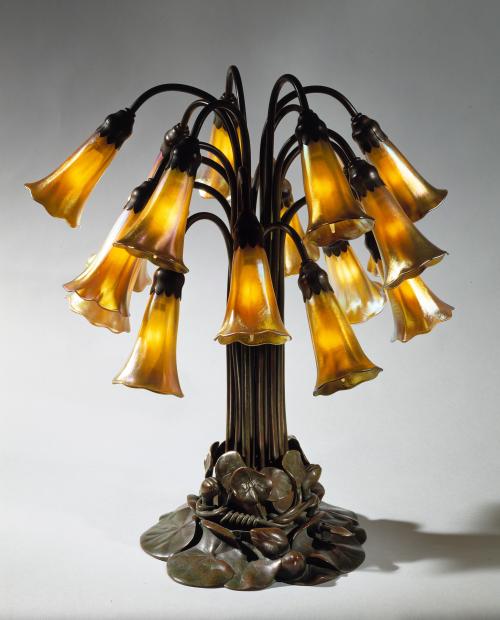

Eighteen Light Lily Lamp
Maker
Louis Comfort Tiffany
(American, 1848 - 1933)
Makerdesigned by
Mrs. Curtis Freschel
(American)
Maker
Tiffany Studios
(American)
ClassificationsDECORATIVE ARTS
Dateafter 1902
Mediumpatinated bronze and gold favrile glass
Dimensionsoverall: 23 1/4 × 17 in. (59.1 × 43.2 cm.)
Credit LineThe Huntington Library, Art Museum, and Botanical Gardens. Purchased with funds from the Art Collectors' Council
Status
On viewTiffany was greatly influenced by the philosophy of the Arts and Crafts Movement and the works of the founder of the movement, William Morris, whom he visited while in England in 1867. Tiffany believed in producing high quality, hand made goods in large numbers. In this way, he succeeded in fulfilling the Arts and Crafts Movement's philosophy of bringing art to the masses. However, Tiffany produced items that ranged from the very affordable to those made exclusively for the upper class. His interest in luxury goods diverged from the Socialist leanings of the English proponents of the Arts and Crafts Movement. Tiffany's designs also reflected the spirit of Art Nouveau, an international style of decoration and architecture which developed in the 1880s and 1890s in opposition to the historicizing Beaux Arts traditions that had dominated art and architecture in the second half of the nineteenth century. The Art Nouveau emphasis on surface decoration and artistic unity linked the movement to Symbolism, but also served as a bridge between the Arts and Craft Movement and early 20th-century modernism.
In 1895, Tiffany added to his glass products of windows and vases by introducing the first leaded-glass lamps for public display. He used many different glass-making techniques which were influenced by works of the French Art Nouveau artist Emile Galle and his own collection of Roman and Middle Eastern glass. Working with bright, vibrant colors, Tiffany kept approximately 200 to 300 tons of glass in his factory with approximately 5000 different colors and types. Since Tiffany believed that women had a better color sense than men, a number of female designers flourished in his studio, particularly in the lamp, window, and enameling departments. Mrs. Curtis Freschel became one of Tiffany's most important lamp designers, creating not only the patterns for drop-cluster lily lamps but also for the Studio's famous wisteria lamps. The golden, glowing 18-light lily lamp was a centerpiece in the Tiffany display at the 1902 Prima Exposizione d'Arte Decorativa Moderna, in Turin, Italy, and Tiffany was awarded the gold medal for this piece. As a sculptural study of two types of lilies -- field lilies for the golden, iridescent blown-glass shades, bending gracefully on arched bronze stems, and water lilies for the richly patinated bronze base -- this lamp stressed the importance of beautiful natural forms as a starting point for Tiffany designs. The lamp was modern in its blown-glass interpretation of natural forms and also in its application of the latest lighting technologies; it was the first Tiffany lamp that allowed bulbs to be hung vertically, rather than extended horizontally or pointed up, offering new ways in which light might be cast.
Object number2001.10