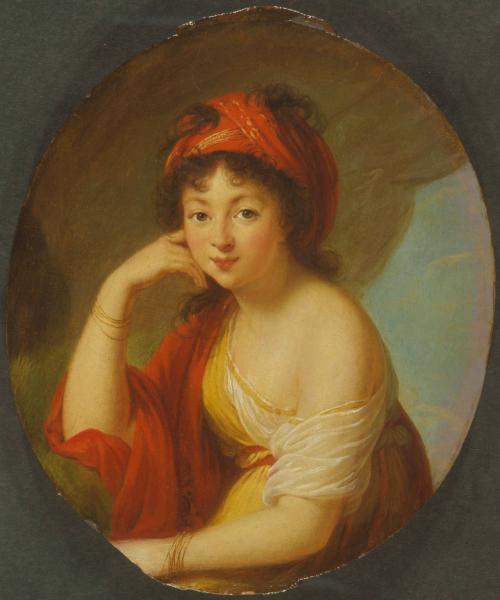

Comtesse Pélagie Róża Potocka Sapieha
Maker
Auguste Louis Jean-Baptiste Rivière
(French, 1761 - 1833)
Afterafter
Elisabeth Louise Vigée-LeBrun
(French, 1755 - 1842)
ClassificationsPAINTINGS
Dateca. 1793 -1794
Mediumoil on panel
Dimensionspanel: 7 × 6 in. (17.8 × 15.2 cm.)
frame: 15 3/4 × 14 1/2 × 2 1/2 in. (40 × 36.8 × 6.4 cm.)
SignedInscribed on verso in black ink: Portrait de Madame Vigée Lebrun / par elle-même peint à Naples
Paper label taped on verso: No. 14739 Size 7x6" / Jeanne Julie Louise LeBrun / (daughter of artist) / Marie Louise Elizabeth Vigée-Lebrun / 1755 1842
InscribedInscribed on verso in black ink: Portrait de Madame Vigée Lebrun / par elle-même peint à Naples
Paper label taped on verso: No. 14739 Size 7x6" / Jeanne Julie Louise LeBrun / (daughter of artist) / Marie Louise Elizabeth Vigée-Lebrun / 1755 1842
Markings
Credit LineThe Huntington Library, Art Museum, and Botanical Gardens. Adele S. Browning Memorial Collection, gift of Mildred Browning Green and Honorable Lucius Peyton Green
Status
Not on viewThis portrait is one of Rivière's "grande miniatures," an oval reduction of Vigée Le Brun's portrait of comtesse Pélagie Roza Potocka Sapieha (1775-1846). The original, rectangular canvas is in the château de Montrésor, France, and depicts the sitter seated in three-quarter length. In 1793, at the age of eighteen, Pélagie, a Polish aristocrat, married Prince Franciszek Sapieha (1772-1829); the couple honeymooned in Vienna, where Vigée Le Brun was living from 1793 to 1794. Vigée Le Brun painted two portraits of the young bride: the one on which the present painting is based, and a second portrait of Pélagie dancing with a shawl, now in the Royal Castle, Warsaw. Historically, the sitter in the present portrait was misidentified as Julie Le Brun, who was one of her mother's favorite subjects.
Object number78.20.17

Jean-Baptiste Oudry
ca. 1710
Object number: 78.20.11